Multi-stop bookings are where transport requests most often go “wobbly” — not because the journey is difficult, but because the details arrive in fragments.
“Can we add one more stop?”
“Actually, the passenger count changes after lunch.”
“We’ve got more luggage than we thought.”
“The meeting might finish early… or late.”
And suddenly a simple plan becomes a long message thread, with the quote (and the vehicle choice) constantly shifting.
At driven.travel, we’re built for this. You submit your journey details once, clearly. We coordinate your booking with a trusted, licensed private hire or chauffeur operator best suited to the itinerary — and you receive a confirmed plan you can rely on.
Here’s the Driven “Itinerary Clinic” approach.
What counts as a multi-stop journey?
A multi-stop booking could be:
- one pick-up, then collecting another passenger elsewhere
- airport pick-up → hotel → meeting → dinner → return
- cruise port collection with a detour to collect family or luggage
- a day hire with several planned locations
- a journey where passengers or luggage change during the day
If anything changes along the route (people, bags, timing), it’s multi-stop — and it’s worth setting it out properly from the start.
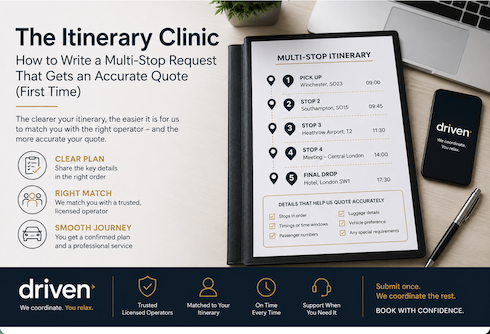
The 60-second multi-stop checklist (copy/paste this into your request)
To quote and plan accurately, we need:
- Stops in order (postcodes if possible)
Write it like: Stop 1 → Stop 2 → Stop 3 → Final drop
- Timing style for each stop
Choose one for each stop:
- Fixed time (“Pick up 10:30”)
- Time window (“Arrive between 10:00–10:30”)
- Wait & return (“Drop off and wait / collect at agreed time”)
- Passenger numbers (and where they change)
Example: “2 passengers from Stop 1, then 4 passengers after Stop 2.”
- Luggage (especially the maximum point)
Tell us the maximum luggage load at any time during the day.
That’s the difference between “fine” and “tight”.
- Vehicle preference (if you have one)
If you don’t, we’ll match the most suitable option based on passengers + luggage + journey type.
- Any special requirements
Mobility aids, walking pace, booster seat needs, tight venue access, extra loading time.
- Your on-the-day contact number
A working mobile number helps when meeting points are busy or access is restricted.
Why this matters (especially for a PA or EA)
For a PA or EA, that means less guesswork and fewer last-minute changes. It also means your traveller is more likely to have the journey experience they expect — calm, comfortable and well organised.
A clear itinerary allows the operator and driver to:
- plan sensible time buffers
- choose the right vehicle first time
- understand where passenger/luggage changes happen
- and keep the day running smoothly even when timings move slightly
Common pitfalls we can prevent — if we know early
The most common causes of disruption are:
- stops added late
- passenger count increasing mid-journey
- luggage underestimated
- timings too tight for real-world traffic and loading time
The fix is simple: tell us the “maximum” scenario up front.
Ready to submit your itinerary?
If you’ve got a multi-stop day coming up — airport plus meetings, a port run with extra pick-ups, or a full London itinerary — submit it clearly once and we’ll coordinate the rest.
Bookings: https://driven.travel/bookings
Contact Us: https://driven.travel/contact